Why a Carbon Water Filtration System Belongs in Every Home
What is a carbon water filtration system?
A carbon water filtration system uses activated carbon media to attract and trap chemical contaminants as water passes through it. Here is a quick breakdown of what you need to know:
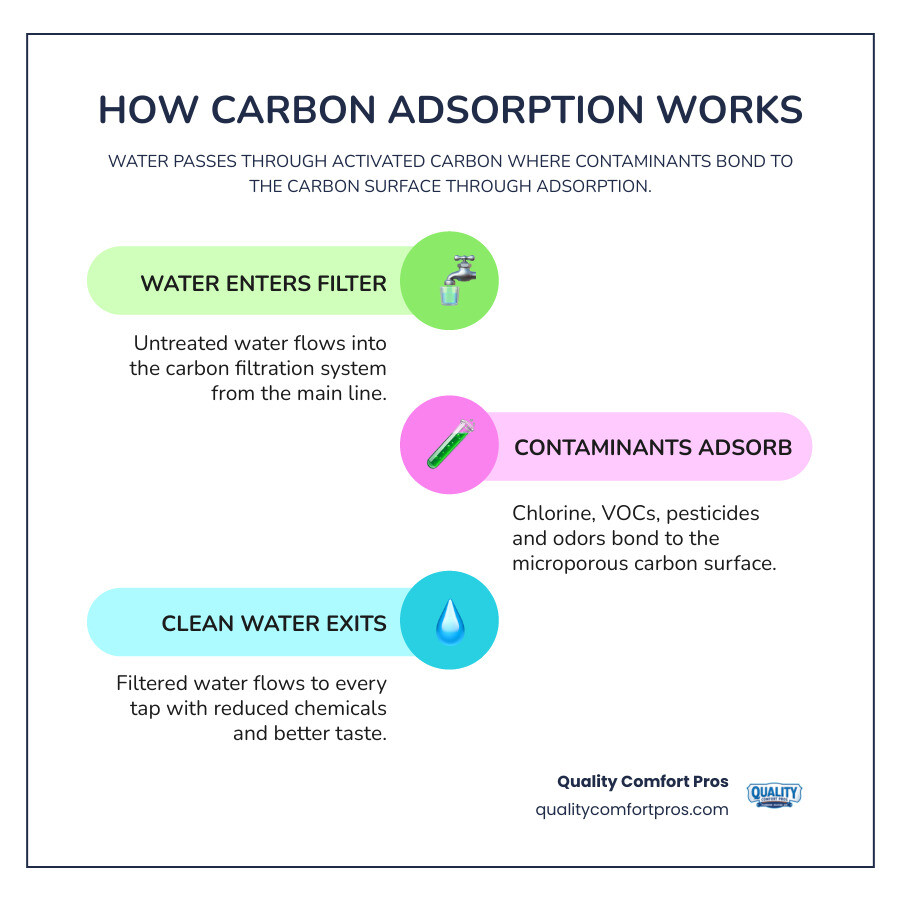
- How it works: Water flows through activated carbon (made from materials like coconut shells, coal, or wood). Contaminants bond to the carbon surface through a process called adsorption.
- What it removes: Chlorine, chloramine, volatile organic compounds (VOCs), pesticides, herbicides, pharmaceuticals, and chemicals that cause bad taste and odor.
- What it does not remove: Total dissolved solids (TDS), nitrates, fluoride, and most heavy metals without additional filtration stages.
- Filter lifespan: Typically 6 to 12 months or up to 100,000 gallons for cartridge systems, and up to 60 months for whole house tank systems on municipal water.
- Best suited for: Homeowners who want cleaner, better-tasting water at every tap without wasting water the way some other filtration methods do.
If you have ever filled a glass of water and noticed a faint chemical smell, or stepped out of the shower feeling like the water was drying out your skin, you are not imagining it. Municipal water treatment relies heavily on chlorine and chloramine to kill pathogens, and while that keeps the water safe to drink, it does not do much for the way water looks, smells, or feels once it reaches your home.
That is exactly the problem a carbon water filtration system is designed to solve. Rather than treating water at a single faucet, a whole house system filters every drop of water that enters your home, from the kitchen sink to the bathroom shower to the washing machine. The result is noticeably cleaner, fresher water throughout the entire house without the waste or complexity of some alternative filtration approaches.
For homeowners in Northern Michigan, where water sources range from municipal supplies to private wells, understanding how carbon filtration works and what it can realistically do for your water quality is genuinely useful knowledge. The geological diversity of our region means that water chemistry can change drastically from one neighborhood to the next, making a reliable filtration strategy essential for long-term peace of mind.
I’m JD Osman, and through my work at Quality Comfort Pros, I have helped homeowners across Northern Michigan evaluate and implement practical carbon water filtration system solutions that fit their homes and their water quality needs. In the sections ahead, we will walk through everything from how these systems work at a mechanical level to how they compare with other filtration technologies, so you can make a confident, informed decision.
What is a Whole House Carbon Water Filtration System?
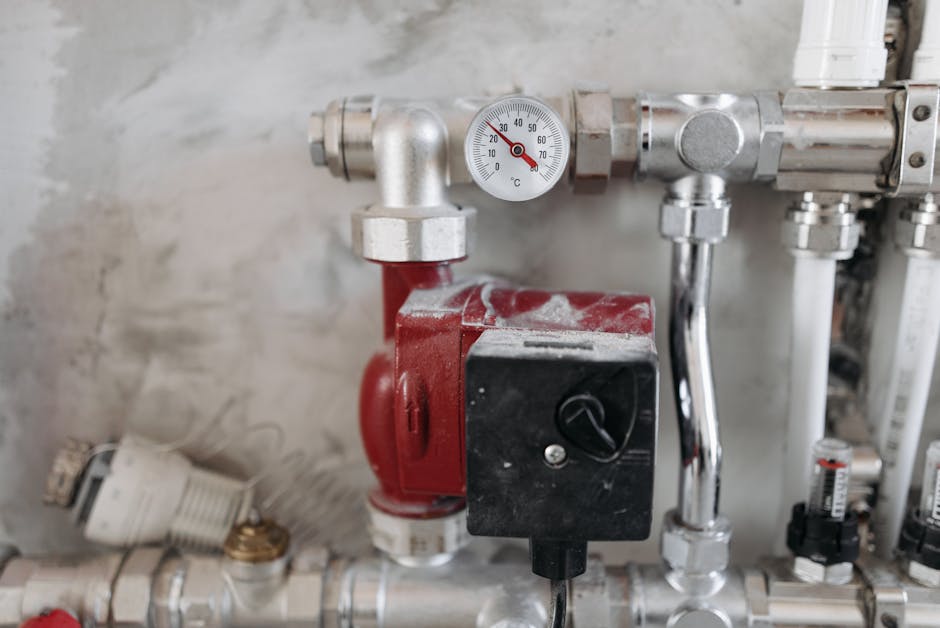
A whole house carbon water filtration system is a point-of-entry system installed where your main water line enters your home. This location ensures that all water used for drinking, cooking, bathing, and laundry is filtered before it ever reaches a single tap or appliance.
Unlike small pitcher filters or under-sink units that only treat water at a single location, a whole house system provides a comprehensive solution for the entire property. This is particularly important for protecting your skin and hair from chlorine exposure in the shower, as well as protecting your plumbing fixtures and water-using appliances from chemical degradation.
When we look at comprehensive water quality solutions for homes in areas like Gaylord, MI or Petoskey, MI, a whole house carbon filter is often the foundation. It acts as a highly effective barrier against organic chemicals, synthetic compounds, and disinfection byproducts that municipal water treatment plants leave behind.
How a Carbon Water Filtration System Works
At the heart of every carbon filter is the process of adsorption. It is easy to confuse adsorption with absorption, but they are physically very different. While absorption involves a fluid being completely soaked into a material (like water into a sponge), adsorption is a surface-level phenomenon.
Activated carbon is manufactured from carbon-rich organic materials such as wood, coal, or, most commonly, coconut shells. This material is heated to extremely high temperatures in the absence of oxygen, a process that “activates” the carbon by creating millions of microscopic pores across its surface. This thermal activation process dramatically increases the internal pore structure, making it highly receptive to organic molecules.
This microporosity gives activated carbon an incredible surface area. In fact, a single gram of activated carbon can have a surface area of over 1,000 square meters. As water flows through this highly porous media, dissolved chemical impurities are drawn to the carbon surface. The contaminants bond to the carbon at a molecular level, effectively trapping them while allowing clean water molecules to pass through freely. This process is exceptionally efficient at organic compound and chlorine reduction.
To maximize the efficiency of this process, water treatment professionals look at empty bed contact time (EBCT). This is the amount of time the water remains in physical contact with the carbon media as it flows through the filter tank. A slower flow rate or a larger volume of carbon media increases this contact time, resulting in a much higher rate of contaminant removal.
Carbon Block vs. Granular Activated Carbon (GAC)
When choosing a carbon water filtration system, you will generally encounter two primary types of carbon media: Granular Activated Carbon (GAC) and Carbon Block. Both utilize the same fundamental chemistry, but their physical structures lead to different performance characteristics.
GAC filters consist of loose, individual granules of carbon. Water flows relatively quickly through these loose granules, which allows for high flow rates with minimal pressure drop. However, because the granules are loose, water can sometimes find the path of least resistance. This is a phenomenon known as channeling, which can prevent some water from contacting the carbon media long enough for complete adsorption.
Carbon block filters, on the other hand, are made of finely ground carbon that has been compressed and bound into a solid, dense block. This structure forces water to pass through uniform, microscopic pathways, completely eliminating the risk of channeling. Carbon blocks offer a much higher surface area and a slower, more controlled filtration rate, which results in more thorough contaminant removal. Additionally, many high-quality carbon blocks can provide mechanical filtration, trapping physical particles as small as 0.5 microns.
| Feature | Granular Activated Carbon (GAC) | Carbon Block |
|---|---|---|
| Physical Structure | Loose carbon granules | Compressed solid block |
| Risk of Channeling | Moderate to High | None |
| Filtration Speed | Fast flow rate | Moderate flow rate |
| Contact Time | Lower | Higher |
| Mechanical Filtration | Minimal | Excellent (down to 0.5 microns) |
| Typical Application | High-flow pre-treatment | Fine chemical and sediment removal |
Contaminants Targeted by Carbon Filtration
Activated carbon is widely recognized as one of the most versatile water treatment technologies available because of the sheer variety of chemical compounds it can address. A high-quality carbon water filtration system can reduce over 65 different contaminants, significantly improving both the safety and the aesthetic quality of your home’s water.
Among the primary targets of carbon filtration are:
- Chlorine and Chloramine: These are the disinfectants used by municipal water systems. While they keep water safe from pathogens during transit, they leave a harsh, chemical taste and odor. Carbon filters are highly effective at breaking down and adsorbing these chemicals.
- Volatile Organic Compounds (VOCs): These carbon-based chemicals can evaporate into the air and dissolve easily in water. They often originate from industrial solvents, fuel runoff, or household cleaners.
- Pesticides and Herbicides: Agricultural runoff can introduce these chemicals into local groundwater. Carbon filters excel at trapping these synthetic organic compounds.
- Pharmaceuticals and Industrial Solvents: Trace amounts of medications and industrial chemicals that bypass municipal treatment plants are readily adsorbed by the dense pore structure of activated carbon.
If you are unsure which of these chemicals might be present in your local supply, getting a professional water quality test is the best way to determine exactly what needs to be targeted in your home.
What Carbon Filters Do Not Remove
While carbon filtration is incredibly powerful, it is not a magic cure-all for every water problem. Understanding its limitations is crucial for designing an effective home water treatment system.
Activated carbon relies on the chemical attraction between carbon-based organic molecules and the carbon media. Because of this, it is highly ineffective at removing substances that do not have a strong chemical affinity for carbon, or those that are completely dissolved as inorganic ions.
Carbon filters do not remove:
- Total Dissolved Solids (TDS): This includes dissolved inorganic minerals like calcium, magnesium, sodium, and potassium.
- Heavy Metals: Dissolved metals like lead, copper, and arsenic are not reliably removed by standard activated carbon alone, though some specialized carbon blocks with chemical additives can reduce them.
- Nitrates and Fluoride: These inorganic compounds do not bond with carbon and will pass right through the filter.
- Microorganisms: Standard carbon filters cannot kill or remove bacteria, viruses, or microscopic cysts. In fact, if a carbon filter is left in place past its service life, it can actually become a breeding ground for bacteria.
For homeowners who need to address these specific inorganic contaminants or require high-purity drinking water, combining a whole house carbon filter with a reverse osmosis water filter installation at the kitchen sink is often the ideal solution. This multi-stage approach ensures that you get the high-flow benefits of carbon filtration throughout the house, while securing ultra-pure water for drinking and cooking.
Comparing Carbon Filtration to Other Technologies
When evaluating how to improve your home’s water quality, it is helpful to compare a carbon water filtration system with other common residential water treatment technologies. Each system is designed to solve different water quality issues, and they often work best when installed in combination.
For detailed engineering standards and performance ratings on whole house systems, you can review the manufacturer specifications on whole house carbon systems to see how various designs manage flow rates and chemical reduction.
Carbon Filtration vs. Reverse Osmosis
The primary difference between carbon filtration and reverse osmosis (RO) lies in their scale, installation point, and filtration intensity.
A whole house carbon filter is a point-of-entry system that treats all the water entering your home at high flow rates. It removes chemicals and organic compounds while leaving healthy minerals intact, and it produces zero waste water.
Reverse osmosis is typically a point-of-use system installed under the kitchen sink. It uses a semi-permeable membrane to strip virtually everything from the water, including dissolved solids, minerals, and heavy metals. However, RO systems operate slowly and require a storage tank. They also generate waste water, typically requiring three to five times more water input than the purified water they produce, with the excess flowing down the drain. To keep these systems running efficiently, homeowners should stay on top of routine RO water filter maintenance to protect the delicate membrane from premature clogging.
Carbon Filtration vs. Water Softeners
It is common to mistake a water softener for a water filter, but they perform entirely different tasks.
A carbon water filtration system is designed to remove chemical contaminants, tastes, odors, and organic pollutants. It does not alter the hardness of your water or remove dissolved minerals like calcium and magnesium.
A water softener is designed specifically to tackle hard water. It uses an ion-exchange process to replace calcium and magnesium ions with sodium ions, preventing scale buildup in your pipes, water heater, and appliances. However, a water softener will not remove chlorine, pesticides, or VOCs.
For many homeowners in Northern Michigan towns like Charlevoix, MI or Boyne City, MI, combining an expert water softener installation with a whole house carbon filter provides the ultimate pairing: soft water that protects the plumbing, and chemical-free water that tastes and smells great. Working together, these systems address both the physical and chemical aspects of water quality, extending the lifespan of your plumbing infrastructure.
Installation and Maintenance of a Carbon Water Filtration System
Installing a whole house carbon water filtration system requires careful planning and precise plumbing integration. Because the system must handle the main water flow for the entire household, it is installed directly on the main water line before the plumbing splits into hot and cold lines.
A professional installation typically includes:
- Bypass Valves: A three-valve bypass loop allows you to redirect water around the filtration system when performing maintenance or filter changes, ensuring your home never loses water pressure during service.
- Pressure Gauges: Installing pressure gauges both before and after the filter system allows you to monitor the pressure drop across the media. A significant drop in pressure indicates that the filter is clogged and needs attention.
- Sediment Pre-Filter: To protect the expensive carbon media from becoming prematurely clogged with physical debris like sand, silt, or rust, a high-capacity sediment pre-filter is installed ahead of the carbon unit.
For homeowners looking to integrate these systems seamlessly into their existing plumbing, scheduling whole house water filtration services with an experienced plumber ensures the system is sized correctly and installed to local building codes.
Lifespan and Replacement of a Carbon Water Filtration System
The lifespan of your carbon filter depends heavily on the type of system you choose, the volume of water your household uses, and the quality of your incoming water supply.
Cartridge-style systems, which often use 20-inch large-capacity filters, generally have a capacity of up to 100,000 gallons. For an average family, this translates to a replacement interval of 6 to 12 months.
In contrast, large whole house tank systems can hold up to 1.5 to 2.0 cubic feet of carbon media. These systems can last up to 60 months (5 years) on municipal water supplies because the water has already been pre-treated for heavy sediment. However, if you are on well water in rural areas like Mancelona, MI or Vanderbilt, MI, the high levels of iron, manganese, and sediment can reduce that lifespan to around 12 months unless proper pre-filtration is in place.
Monitoring for a gradual pressure drop or a return of chlorine taste and odor is the best way to know when your system’s carbon media has reached its saturation point.
Outdoor Installation Requirements
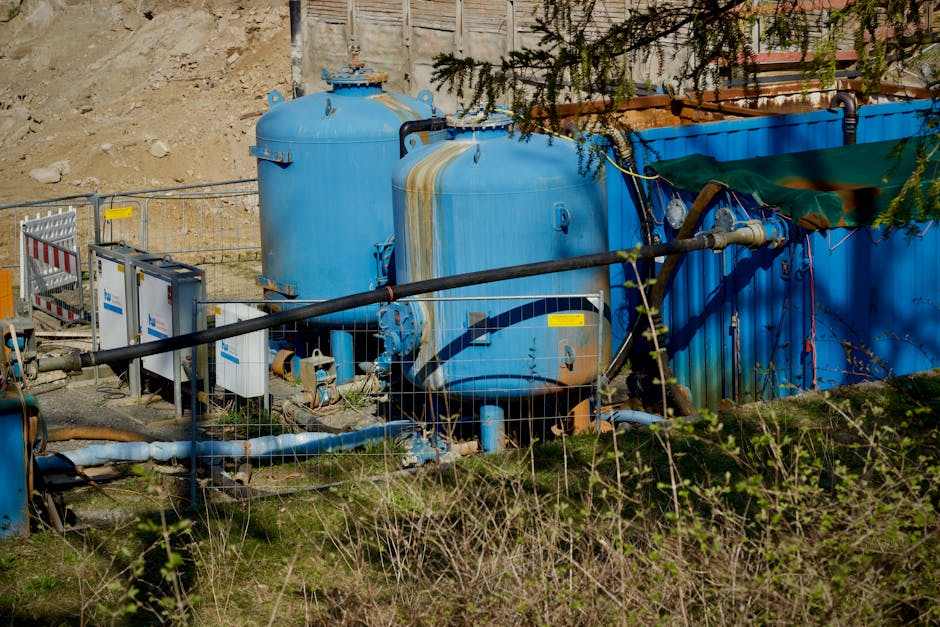
In some homes, the only accessible spot for the main water line is in an attached garage, a carport, or a crawlspace. While a carbon water filtration system can be installed in these areas, you must take specific precautions to protect the equipment.
First and foremost, the system and its control valves must never be exposed to freezing temperatures. In Northern Michigan, our winters are notoriously harsh. If water freezes inside a carbon tank or filter housing, the plastic or fiberglass will crack, leading to catastrophic water damage once it thaws. If installed in an unheated space, the system must be properly insulated or heat-taped.
Additionally, the system should be shielded from direct sunlight and heavy precipitation. Prolonged exposure to UV rays can degrade plastic filter housings and control valve components over time. If outdoor installation in a covered structure like a carport is necessary, utilizing a weather cover or a protective enclosure is highly recommended.
Frequently Asked Questions About Carbon Water Filtration
Do carbon water filters remove bacteria and viruses?
No, standard carbon filters do not remove or kill bacteria, viruses, or other microorganisms. If your water source has microbiological contamination, you should pair your carbon system with a UV disinfection system or a chemical oxidation system.
How do I know when to replace my carbon filter?
You will typically notice a drop in water pressure throughout your home, or you may notice that the unpleasant chlorine taste and odor have started to return to your drinking water. As a general rule, cartridge filters should be changed every 6 to 12 months.
Does a carbon filter reduce water pressure?
A properly sized whole house carbon filter will cause a minimal, almost unnoticeable pressure drop (usually less than 1 to 2 psi) when first installed. However, as the filter traps sediment and organic compounds over time, it will eventually clog, which can significantly reduce your home’s water pressure.
Can I use a carbon filter on well water?
Yes, but well water often requires extra pre-treatment. Well water in Northern Michigan can contain high levels of iron, sulfur, and sediment, which can quickly clog and ruin standard carbon media. Installing a sediment pre-filter or an iron filtration system ahead of the carbon filter is essential.
What is the difference between catalytic carbon and activated carbon?
Catalytic carbon is a specialized form of activated carbon that has undergone additional processing to enhance its ability to promote chemical reactions. While standard activated carbon is great for chlorine, catalytic carbon is highly effective at removing chloramines, hydrogen sulfide (which causes a rotten egg smell), and iron.
Does carbon filtration remove healthy minerals?
No. Carbon filters do not remove dissolved minerals like calcium, magnesium, or potassium. These minerals do not bond to the carbon media, meaning they remain in your drinking water.
Do I need a sediment pre-filter with a carbon system?
Yes. Carbon media is highly porous and designed to adsorb dissolved chemicals. If raw water containing dirt, rust, or sand flows directly into the carbon, those physical particles will clog the microscopic pores, ruining the carbon long before its chemical capacity is exhausted.
Can a carbon filter remove fluoride?
Standard activated carbon filters do not remove fluoride. If fluoride reduction is a priority for your household, you will need a specialized filtration system, such as an alumina-based filter or a reverse osmosis system.
How does carbon filtration affect water taste and odor?
Carbon filtration dramatically improves water taste and odor by removing chlorine, chloramines, sulfur compounds, and organic chemicals. It turns metallic or chemical-tasting tap water into crisp, clean-tasting water.
Is professional installation required for a whole house carbon filter?
While some handy homeowners attempt a DIY installation, professional installation is highly recommended. Properly integrating the system into your main water line, installing bypass loops, and ensuring leak-free connections requires specialized plumbing tools and expertise.
Conclusion
Investing in a carbon water filtration system is one of the most practical and effective steps you can take to improve your home’s water quality. By removing chlorine, chemicals, and organic impurities at the point of entry, you protect your plumbing, extend the life of your appliances, and enjoy clean, fresh water from every single tap.
At Quality Comfort Pros, we have spent 28 years providing reliable, family-owned home services to our neighbors across Northern Michigan. Whether you are dealing with municipal chlorine in Gaylord, MI, or challenging well water in Bellaire, MI, our team of plumbing experts is ready to help you find the perfect water treatment setup.
Whether you need a new water treatment setup, routine system maintenance, or a comprehensive water analysis, the team at Quality Comfort Pros is ready to help. Schedule your professional water filtration services today to enjoy clean, refreshing water throughout your entire home.