Why a Ductless Mini Split Could Be the Smartest Upgrade for Your Home
A ductless mini split is a heating and cooling system that works without any ductwork. It connects an outdoor compressor to one or more indoor air handlers through a small hole in the wall.
Here’s a quick summary of what you need to know:
| Feature | Details |
|---|---|
| What it does | Heats and cools individual rooms or zones |
| Main components | Outdoor compressor + indoor air handler(s) |
| Energy efficiency | 18 to 42 SEER ratings, far above most central AC systems |
| Noise level | As low as 19 dBA indoors, quieter than a whisper |
| Typical cost | $2,000 to $7,000 per zone, installed |
| Lifespan | 15 to 20 years with proper maintenance |
| Best for | Homes without ducts, room additions, zoning, older homes |
If you’re dealing with uneven temperatures, high energy bills, or a home that was never set up for central air, a ductless mini split is worth a serious look.
Traditional ducted systems can lose more than 30% of their energy through leaky or poorly insulated ductwork. A mini split skips all of that. You get precise, room-by-room control, with no ducts required.
For Northern Michigan homeowners, where winters are long and summers can surprise you, that kind of flexibility and efficiency matters.
I’m JD Osman, and throughout my career in business operations and home services, I’ve seen how the right ductless mini split system can transform year-round comfort, especially in climates as demanding as Northern Michigan’s. In this guide, I’ll walk you through everything you need to know to make a confident decision.
What is a Ductless Mini Split and How Does It Work?
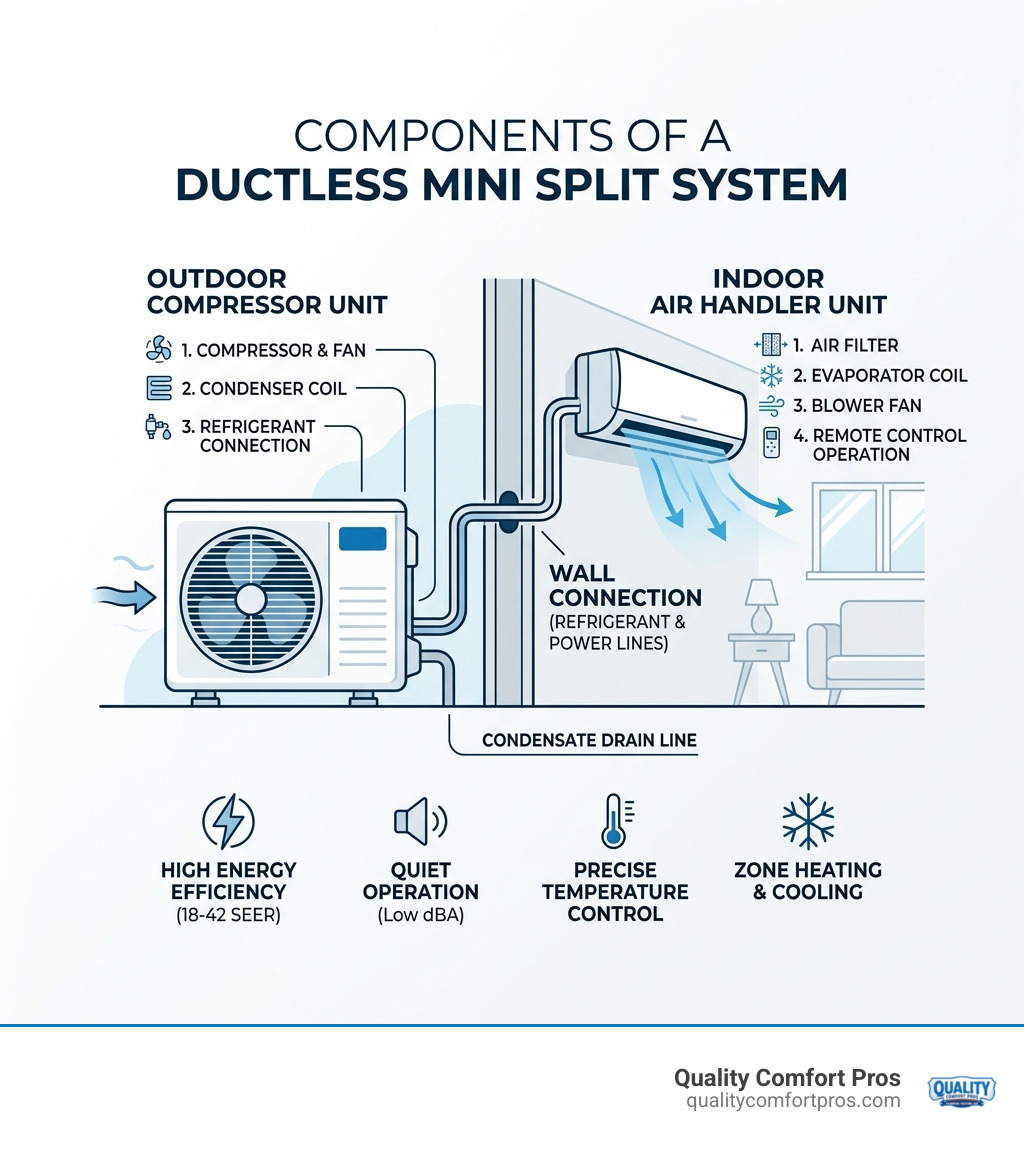
At its core, a ductless mini split is a highly efficient heating and cooling system designed to control the temperature in individual rooms or “zones.” Unlike traditional central HVAC systems that rely on a network of bulky ducts to move air, these systems are “ductless.” This makes them a game-changer for older homes in places like Bellaire or Boyne City that weren’t built with ductwork in mind.
So, how does the magic happen? The system consists of two primary parts: an outdoor compressor (or condenser) and one or more indoor air-handling units. These two components are linked by a conduit that houses the power cable, refrigerant tubing, suction tubing, and a condensate drain.
According to the Department of Energy, the indoor unit is mounted directly in the room it serves. When you want cooling, the system pulls heat from the indoor air and transfers it to the outdoor unit via the refrigerant lines. Because it uses inverter-driven compressors, the system doesn’t just blast on and off like a traditional AC. Instead, it speeds up or slows down to maintain a perfectly steady temperature.
This technology is essentially a specialized heat pump. In the summer, it moves heat out of your house. In the winter, it reverses the process, extracting heat from the outdoor air (yes, even when it’s cold!) and pumping it inside. For a deeper look at how these are set up, check out our page on ductless mini split installation.

Key Benefits and Advantages of Ductless Systems
Why are so many people in Gaylord and Petoskey switching to a ductless mini split? The benefits go far beyond just “staying cool.”
One of the biggest advantages is efficiency. Traditional central air systems lose a massive amount of energy, often more than 30%, simply by pushing air through ducts. If those ducts are in a hot attic or a crawlspace, that’s money literally leaking out of your house. By eliminating ducts, you keep that 30% in your pocket.
Another huge win is “zoning.” With a multi-zone system, you can keep your bedroom at a crisp 68 degrees while leaving the guest room or sunroom unconditioned when they aren’t in use. This level of control is something central HVAC simply can’t match.
Then there’s the noise, or lack thereof. Many indoor air handlers have sound ratings as low as 19 dBA. To put that in perspective, a whisper is about 30 dBA. You’ll likely forget the unit is even running. Furthermore, because there are no ducts to collect dust, pollen, and pet dander, many homeowners find that their indoor air quality improves significantly. For those living in historic homes in Northern Michigan, we’ve compared the two styles in our guide on ducted vs ductless cooling in older homes.
Energy Efficiency and SEER Ratings for a Ductless Mini Split
When shopping for a ductless mini split, you’ll see a lot of talk about SEER (Seasonal Energy Efficiency Ratio) ratings. Think of SEER like MPG for your car, the higher the number, the less energy it uses.
Most standard central AC units hover around 14 to 16 SEER. In contrast, ductless systems typically start at 18 SEER and can go all the way up to an incredible 42 SEER. This efficiency is why many models earn the ENERGY STAR label.
In Northern Michigan, high efficiency isn’t just about being green; it’s about surviving those utility bill spikes. To make sure your system is ready for the peak season, it’s a good idea to follow a spring prep for mini split AC in homes. Plus, high-efficiency systems often qualify for local utility rebates and federal tax credits (up to $2,000 in some cases), which can help offset the initial cost.
Year-Round Comfort with a Ductless Mini Split Heat Pump
Can a ductless mini split really handle a Northern Michigan winter? The short answer is: Yes, provided you choose the right model.
Modern “cold climate” heat pumps are engineered to provide reliable heating even when outdoor temperatures drop to 5°F or lower. They use a reversing valve to switch the flow of refrigerant, allowing the system to gather heat from the outside air and bring it indoors.
While older heat pumps used to struggle in the snow, today’s technology is much more robust. However, in areas like Mancelona or Atlanta, MI, where temperatures can stay below zero for days, we often recommend having a backup heat source (like your existing furnace or baseboard heat) just in case. We have some great tips on how to keep mini split running in cold weather to ensure you stay cozy all winter long.
Sizing, Types, and Configuration Options
Choosing the right ductless mini split isn’t a “one size fits all” situation. If the unit is too small, it will run constantly and never get the room comfortable. If it’s too large, it will “short cycle,” turning on and off so fast that it fails to dehumidify the air, leaving your room feeling clammy.
We use a “Manual J” load calculation to determine the exact BTU (British Thermal Unit) capacity your space needs. Factors like the number of windows, ceiling height, and insulation levels all play a role.
You also have choices in how the system looks:
- Wall-Mounted: The most common and affordable option, sitting high on a wall.
- Floor-Mounted: Great for rooms with low ceilings or where wall space is taken up by windows or art.
- Ceiling Cassettes: These sit flush with the ceiling for a very discreet look.
- Slim Duct: These are hidden behind a wall or in a ceiling, using a very small amount of ductwork to serve one or two nearby vents.
Whether you need a single-zone for a new sunroom or a multi-zone system for your whole house, we can help you navigate the ductless mini split replacement process.
Professional vs. DIY Installation Considerations
It’s tempting to look at a DIY kit online and think, “I can do that over a weekend.” But there are several reasons why a professional touch is vital for a ductless mini split.
First, there’s the refrigerant. Handling refrigerant requires specialized tools and an EPA certification. If the lines aren’t vacuumed and charged correctly, the system will lose efficiency and could burn out the compressor within a few years.
Second, there is the electrical work. These systems usually require a dedicated 220V circuit and a disconnect box near the outdoor unit. Finally, there’s the warranty. Most major manufacturers will only honor their 5- to 12-year warranties if the system was installed by a licensed professional. For a look at how we handle the tech side of things, read about smart mini split AC installation for homes.
Understanding Costs, Maintenance, and Lifespan
Let’s talk numbers. A ductless mini split installation typically costs between $2,000 and $7,000 per zone. A single-zone system for a garage might be on the lower end, while a complex five-zone system for a large home in Charlevoix will naturally be higher.
While the upfront cost can be higher than a window unit or even some central air replacements, the long-term savings are significant. A high-quality system can last 15 to 20 years if you take care of it.
Maintenance is relatively simple but non-negotiable. The most important thing you can do is clean the air filters every month or two. Beyond that, you should have a professional perform an annual tune-up to check refrigerant levels and clean the outdoor coils. You can learn more about keeping your system in top shape on our ductless mini split maintenance page. And if things ever go sideways, we’re always here for ductless mini split repair.
Frequently Asked Questions about Ductless HVAC
How much does a mini split cost to run compared to central air?
Because they don’t lose energy through ducts and allow you to turn off units in rooms you aren’t using, mini splits are generally much cheaper to run. Homeowners often see a 20% to 50% drop in their cooling costs after switching from central air or window units.
Can I install a mini split in a garage or sunroom?
Absolutely! Garages, sunrooms, and “bonus rooms” over the garage are the most popular places for a single-zone ductless mini split. They are perfect for spaces where extending your existing ductwork would be too expensive or physically impossible.
How often should I clean the filters on my indoor unit?
For most homes, every 4 to 6 weeks is ideal. If you have pets or live in a dusty area (like near a dirt road in Vanderbilt or Johannesburg), you might want to check them every 2 weeks. It only takes a few minutes, just pop the front panel, rinse the plastic filters in the sink, let them dry, and put them back.
Conclusion
At Quality Comfort Pros, we’ve spent 28 years providing reliable, expert, and family-owned solutions to our neighbors across Northern Michigan. From Gaylord to Petoskey and everywhere in between, we understand the unique challenges of heating and cooling homes in our beautiful but rugged climate.
A ductless mini split is more than just a luxury; for many of our clients, it’s the key to finally enjoying every room in their house, regardless of the season. Whether you’re looking to save on energy bills, add comfort to a new addition, or finally get rid of those noisy window units, we’re here to help.
Ready to see if a ductless system is right for you? Schedule your ductless mini split installation with us today and experience the difference that 28 years of local expertise can make.