
Get Emergency Gas Leak Help Safely
If you suspect a gas leak, get everyone and pets outside immediately, do not operate light switches, appliances, vehicles, or phones indoors, and call 911 or your gas utility from a safe location. Once emergency responders or the utility have addressed the immediate hazard, hire licensed professionals for gas leak detection services to locate the source, document the issue, and coordinate a safe repair.
Natural gas is colorless and naturally odorless, and its added rotten-egg scent is an important warning sign, not a guarantee. A leak may also reveal itself through hissing near a pipe or appliance, dead grass above a buried line, bubbling soil, damaged connections, or an unexplained rise in gas use. Hidden and slow leaks deserve the same caution because odor can fade or become harder to notice over time.
This guide breaks the process into five simple steps, from recognizing warning signs to choosing a qualified contractor and confirming the repair is safe. The goal is not to diagnose a suspected leak yourself. It is to make the right safety decision quickly and get reliable professional help.
At Quality Comfort Pros, our home-services team brings decades of customer-focused operations, safety-conscious service, and practical problem-solving to Northern Michigan homeowners who need prompt gas leak guidance and professional support.

Step 1: Recognize the Critical Warning Signs of a Gas Leak
Spotting a gas leak quickly is essential for protecting your property and family. Because natural gas is naturally invisible and odorless, utility providers add a chemical odorant called mercaptan, which smells distinctly like sulfur or rotten eggs. While this pungent odor is often the primary warning sign, leaks can also manifest through distinct auditory and physical cues around your living spaces.
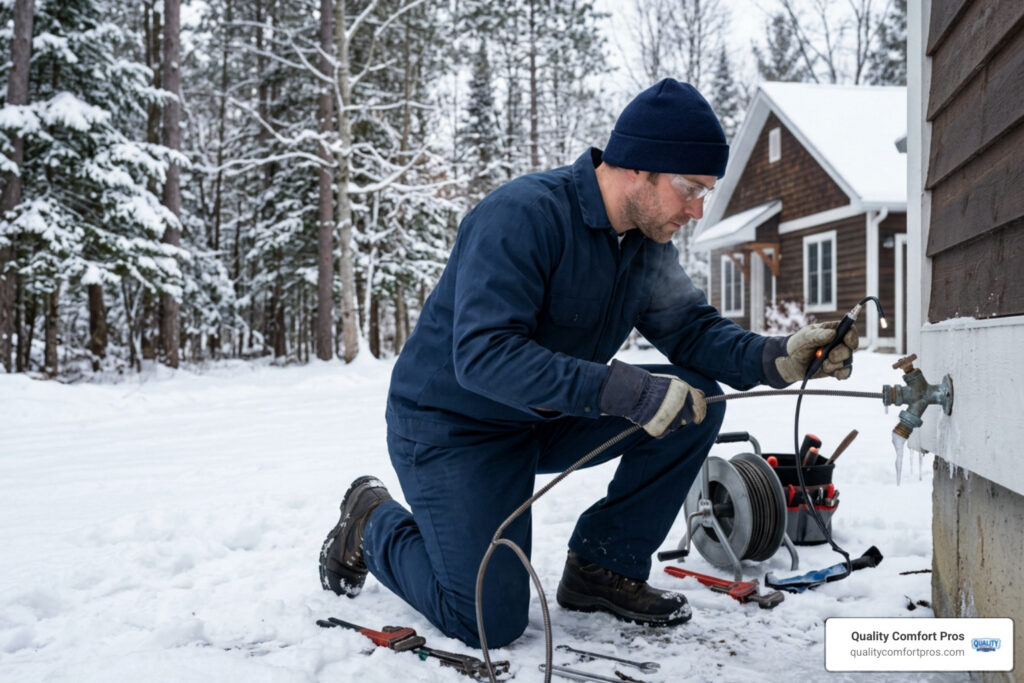
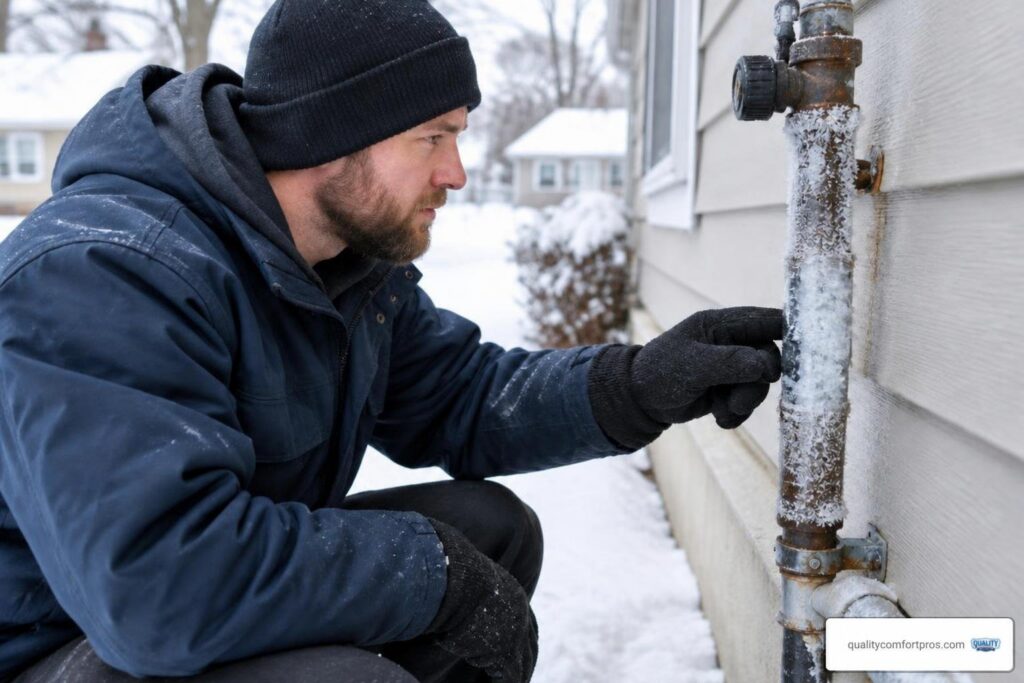
Listen carefully around your furnace, water heater, kitchen range, and outdoor supply risers. A persistent hissing, whistling, or roaring sound along a pipe run or near an appliance connection usually points to pressurized gas escaping through a compromised seal, rusted fitting, or cracked pipe wall.
Outside your home, environmental clues often signal trouble underground:
- Vegetation die-off: Gas displacing oxygen in the dirt will cause patches of healthy green lawn, garden beds, or shrubs to suddenly turn brown and wither.
- Bubbling surface water: Leaking underground lines under standing puddles or moist ground will create steady streams of air bubbles breaking the surface.
- Blowing dust: High-pressure underground leaks can blast dirt, leaves, or soil particles upward into the air without any wind present.
- Struggling indoor plants: Houseplants that suddenly wilt, drop leaves, or yellow despite proper watering can indicate small, ambient concentrations of combustible fuel inside the living space.
Physical health symptoms can also emerge when occupants are exposed to slow, accumulating gas leaks. Common warning signs include unexplained fatigue, dizziness, headaches, nausea, irritation of the eyes and throat, or sudden breathing difficulties. If your pets act unusually lethargic or agitated near specific utility closets, treat that behavior as a serious warning. Equipping your home with automated monitoring tools like a plumbing kit valves insulation sensors package helps catch subtle utility abnormalities before they threaten your safety.
Step 2: Follow Immediate Emergency Evacuation and Safety Protocol
When you observe any physical, environmental, or sensory indicators of a fuel leak, safety must take absolute precedence over everything else. Fuel vapors mixed with air create an explosive atmosphere, requiring only a microscopic spark to ignite.
Follow this straightforward emergency sequence immediately:

- Evacuate the structure instantly: Gather every family member and pet and leave the building immediately. Leave the main entry doors open behind you as you exit to assist natural ventilation.
- Eliminate all ignition sources: Do not flip any light switches on or off, do not unplug appliances, do not ring doorbells, and do not use garage door openers. Even the static charge from walking on synthetic carpet or moving plastic pipes can generate enough voltage to ignite fuel vapor.
- Avoid electronics indoors: Never use landlines, mobile phones, or handheld flashlights while inside the contaminated space. Keep your phone in your pocket until you are well away from the perimeter.
- Never start motor vehicles: Do not turn the ignition on a car parked inside an attached garage or right next to the structure, as engine starter motors generate electrical arcing.
- Call emergency dispatch from a safe distance: Once you are at least 300 feet away from the home, dial 911 and contact your local utility provider.
If your outdoor main gas shutoff valve is accessible and you can operate it quickly without lingering in danger, turn the valve a quarter turn so it sits perpendicular to the pipe. If you are unsure how to operate it, leave it alone and let first responders handle it.
After emergency officials confirm the immediate perimeter is stable and the main supply is secured, you will need to arrange for professional diagnostics. For situations involving compromised home infrastructure, contact a qualified plumbing professional quickly so the integrity of your interior and exterior lines can be evaluated.
Step 3: Understand How Professional Gas Leak Detection Services Work
Locating a leak accurately requires specialized scientific instrumentation and certified diagnostic techniques. Professional gas line technicians use systematic methods to verify line integrity, pinpoint sub-surface faults, and ensure no micro-leaks are left behind.
When an expert arrives on site, they do not simply guess or tear into finished walls. They begin with non-invasive isolation tests. Technicians apply sensitive digital manometers to your gas manifolds to run pressure decay tests. By isolating sections of your supply plumbing and measuring pressure loss over time, they can confirm whether your home has an active leak and calculate its relative severity down to fractions of an ounce of pressure.
Modern detection strategies utilize multi-layered screening methods:
- Acoustic listening diagnostics: High-frequency listening devices amplify the sound of high-pressure gas escaping through microscopic pinholes hidden behind drywall, under subflooring, or deep below frozen turf.
- Laser spectroscopic analysis: Precision optical detectors analyze air samples across open spaces to identify methane concentrations with pinpoint accuracy.
- Tracer gas evaluation: Technicians can introduce harmless inert gas mixtures into an isolated line segment to trace escape paths through concrete slabs without invasive digging.
Diagnostic Equipment Used in Gas Leak Detection Services
Modern leak detection relies on sensitive electronic tools calibrated to detect combustible fuels down to minute thresholds. Technicians use combustible gas indicators (CGIs) that display gas concentrations in parts per million (PPM) or as a percentage of the lower explosive limit (LEL). Industry-grade infrared cameras also allow specialists to visualize invisible gas plumes escaping from flues, valves, and mechanical fittings by detecting specific infrared absorption bands.
Specialized mobile diagnostic systems provide extreme sensitivity for larger properties and underground line surveys. Advanced pipeline analysis systems can use optical spectroscopy to measure methane and other gas signatures at very low concentrations. This allows technicians to help distinguish utility gas from naturally occurring methane sources while surveying larger areas from a safe distance.
Why Odor Alone Is Not Enough for Gas Leak Detection Services
Relying exclusively on your sense of smell to determine whether your home is safe can be dangerous. While federal pipeline safety codes mandate that utility gas be odorized to be detectable at one-fifth of the lower explosive limit, roughly 1 percent gas in air, several natural physical processes can strip or mask this scent.
The most critical hazard is known as odor fade. When natural gas travels through new steel piping, dry soil, or heavy clay, chemical adsorption and oxidation can strip the mercaptan molecules out of the gas stream entirely, leaving a potent concentration of combustible fuel that has no aroma at all.
Furthermore, prolonged low-level exposure causes olfactory fatigue, quickly numbing your nose to the sulfur smell. Respiratory infections, seasonal allergies, or household cooking odors can also blind your senses to a building hazard. Because undetected leaks can lead to property damage or serious injury, relying on calibrated electronic instrumentation is the only dependable way to confirm your building is safe.
Step 4: Evaluate Credentials Before Choosing a Contractor
When hiring a contractor to assess and diagnose gas piping, verifying proper trade credentials is vital. Working on combustible fuel lines requires specialized licensing, extensive technical safety training, and formal Operator Qualification (OQ) compliance.
Before authorizing any technician to work on your fuel delivery systems, verify the following:
- State plumbing and mechanical licensing: Ensure the contractor holds current master plumbing or specialized gas fitting credentials for your jurisdiction.
- Comprehensive liability insurance: Confirm the contractor maintains full commercial general liability coverage and active workers’ compensation protection.
- Calibrated detection equipment: Ask if their technicians carry certified electronic sniffers, digital manometers, and acoustic locate tools.
- Documented reporting: Ensure the provider supplies an itemized technical report outlining the exact location, cause, and severity of any line compromises.
Pricing for specialized leak locating varies by property layout, line accessibility, urgency, and whether the issue requires after-hours dispatch. Reputable providers should explain the diagnostic process clearly, identify the failure location when possible, and quote any line reconstruction or component replacement separately based on project scope. Reviewing your policy terms with your homeowner’s insurance carrier is also recommended, as many policies cover structural damage caused by sudden utility failures, even if routine wear-and-tear line repairs remain the property owner’s responsibility.
The table below outlines common professional diagnostic methods, their operational applications, and their detection capabilities:
| Detection Method | Typical Application | Detection Capability & Accuracy | Primary Advantage |
|---|---|---|---|
| Electronic Combustible Gas Sniffers | Exposed fittings, indoor appliances, valve connections | Accurate to 1 PPM; detects immediate vapor point sources | Rapid pinpointing of active indoor joint leaks |
| Digital Pressure Decay Manometers | Whole-system pipe isolation testing | Measures pressure drops down to 0.01 PSI | Confirms leak presence across hidden runs without demolition |
| Acoustic Ultrasonic Detectors | Buried yard lines, interior wall cavities, concrete slabs | High-frequency acoustic sensors filter ambient room noise | Non-invasive locating through thick subfloors and masonry |
| Infrared Optical Gas Imaging | Industrial mechanical rooms, large commercial manifolds | Visualizes real-time gas absorption plumes | Broad area visual scanning of high-elevation piping |
| Tracer Gas Pressurization | Under-slab residential runs, deep underground mains | Non-flammable gas trace down to microscopic pinholes | Pinpoints leaks through concrete without slab cutting |
Step 5: Coordinate Safe Gas Line Repairs and Preventive Maintenance
Once diagnostic tests locate the source of the leak, prompt and code-compliant repairs must be completed before utility service can be restored. Natural gas lines demand precise pipe threading, appropriate sealing compounds, and approved structural supports.
Our experienced technicians execute long-lasting solutions for your fuel delivery infrastructure:
- Corroded line remediation: Replacing aged black iron or degraded galvanized piping with modern, corrosion-resistant coated steel or approved corrugated stainless steel tubing.
- Appliance connector replacement: Installing heavy-duty flexible appliance connectors and modern quarter-turn shutoff ball valves at every connection point.
- Underground line restoration: Trenching and installing certified high-density polyethylene (HDPE) gas lines equipped with continuous tracer wire for future locate safety.
- Joint and union rebuilds: Disassembling worn mechanical unions and rebuilding fittings using industrial PTFE pipe thread sealants formulated specifically for fuel gases.
After completing any line reconstruction, our specialists perform mandatory post-repair pressure testing, pressurizing the isolated system with air to verify that the lines hold pressure with zero decay. For urgent help with compromised gas-adjacent plumbing infrastructure, Quality Comfort Pros can provide emergency plumbing service and dependable plumbing leak repair so your household can move toward a safer repair plan.
For longer-term prevention, homeowners can also strengthen their safety routine with practical guidance from our gas leak detection sensor guide and broader leak detection planning tips.
Frequently Asked Questions About Gas Leak Detection
What are the earliest warning signs of an indoor natural gas leak?
The earliest warning sign of an indoor natural gas leak is usually a subtle sulfur or rotten-egg odor near appliances or utility closets. Other early indicators include unusual whistling or hissing sounds near pipe joints, houseplant leaves yellowing and dying without cause, unexplainable physical symptoms like mild headaches and sudden fatigue, or a steady increase in your monthly gas bill without a change in household usage.
What immediate steps should I take if I smell gas in my home?
If you smell gas inside your home, evacuate every occupant and pet immediately without pausing to collect belongings. Do not touch any light switches, electrical outlets, garage door openers, or landline phones, and avoid using your mobile phone until you are safely outside. Once you are at least 300 feet away from the structure, call 911 and your local gas utility provider to report the emergency.
How much do professional gas leak detection services cost?
The overall cost for professional gas leak detection depends on several factors, including whether the service is scheduled during standard business hours or requires emergency dispatch, the total square footage of the property, and the accessibility of the piping. Standard diagnostics generally involve a flat evaluation fee for pinpointing the leak source, with comprehensive line reconstruction or extensive excavation quoted separately based on project scope.
Can a buried gas line leak without producing an odor?
Yes, a buried natural gas line can leak without producing any noticeable smell. When natural gas escapes underground, passing through dense soil, sand, or heavy clay can absorb the added mercaptan odorant through a natural chemical filtering process known as odor fade. In these situations, dead patches of grass, soil bubbling under standing water, or dirt blowing into the air serve as key indicators of an underground line leak.
Why is relying solely on your sense of smell dangerous for gas detection?
Relying exclusively on your nose is dangerous because human smell can be compromised by olfactory fatigue, which happens when your senses adapt to a continuous low-level scent and stop registering it. Furthermore, common health issues such as colds, sinus infections, and allergies can diminish your sense of smell. Environmental masking from cooking scents, coupled with soil-induced odor fade, makes electronic detection instruments far more reliable.
How long does a comprehensive residential gas leak inspection take?
A standard residential gas leak inspection typically takes between 45 minutes and two hours, depending on the number of gas appliances, the overall size of the home, and the accessibility of the pipe network. Testing individual appliance connections takes only a few minutes each with electronic sniffers, while whole-house pressure decay testing on the isolated line requires a dedicated monitoring period to confirm absolute pressure stability.
What are the most common causes of residential gas line leaks?
The most common causes of residential gas line leaks include age-related pipe corrosion, shifting foundations that stress mechanical joints, damaged or deteriorated flexible appliance connectors, poorly installed aftermarket fittings, and accidental punctures from DIY remodeling or exterior digging. Regular ground settling and winter freeze-thaw cycles can also loosen underground fittings over time.
Does standard homeowners insurance cover gas leak detection and line repair?
Standard homeowners insurance policies typically cover secondary property damage caused by a sudden, unexpected gas explosion or fire, but they often exclude routine leak detection and normal wear-and-tear pipe repairs. Coverage varies based on individual policy terms and endorsements, so homeowners should consult their insurance agent to verify coverage limits for utility line failures.
What regulatory standards govern gas leak detection equipment and procedures?
Professional gas leak detection procedures and diagnostic equipment must comply with federal pipeline safety standards established under 49 CFR Part 192, along with applicable state public utility commission guidelines. These regulations govern required odorant concentrations, leak severity classifications, operator qualification (OQ) training standards, and mandatory periodic calibration schedules for electronic combustible gas indicators.
Is it safe to remain inside if I only suspect a very minor gas leak?
No, it is never safe to remain inside a building when you suspect any level of gas leak. Minor leaks can quickly accumulate inside closed interior spaces, reaching the lower explosive limit (LEL) where even a tiny electrical spark from an appliance motor, light switch, or static discharge could trigger an explosion. Always evacuate immediately and let emergency responders clear the home.
Conclusion
Gas leaks are serious safety hazards that demand immediate attention, sound judgment, and experienced technical service. Recognizing warning signs like sulfur odors, hissing pipes, dying vegetation, or unexplained health symptoms allows you to evacuate quickly and protect everyone in your home. Once first responders have secured the area, calling licensed professionals ensures that your supply infrastructure is thoroughly tested, pinpointed, and repaired to the highest safety codes.
For 28 years, Quality Comfort Pros has provided reliable, family-owned home comfort solutions across Gaylord, MI, and surrounding Northern Michigan communities including Petoskey, MI, Boyne City, MI, Charlevoix, MI, and Grayling, MI. Whether you need urgent diagnostic support, comprehensive system upgrades, or seasonal maintenance across heating, cooling, plumbing, HVAC, AC, A/C, and generator systems, our licensed team is here to help. If you have concerns about your gas piping or need prompt assistance, please contact our professional gas leak detection technicians today.