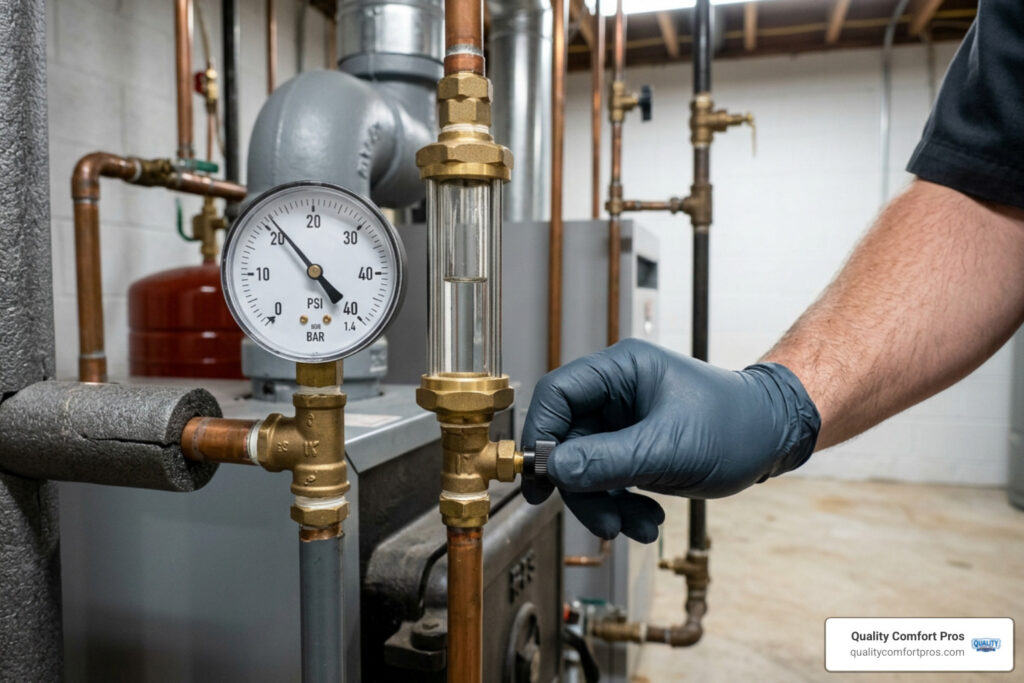

A water heater cross connection fix is the process of identifying and repairing a plumbing fault where cold water leaks into your hot water lines, or vice versa, causing lukewarm water, unpredictable temperature swings, or a tankless heater that refuses to fire.
Here is how to fix a water heater cross connection:
- Confirm the crossover: Shut off the cold water inlet valve at the water heater, then open a hot water tap. If water continues to flow, you have a cross connection.
- Isolate the source: Turn off the local shut-off valves, also called angle stops, to individual fixtures one at a time until the flow stops. That fixture is your culprit.
- Replace the faulty component: The most common fix is replacing the worn cartridge inside a single-handle shower or faucet valve. Other causes include failed recirculation check valves, open washing machine bypasses, or utility sink Y-hose connections.
- Restore and verify: Turn the water supply back on, run each fixture for at least 30 seconds, and use a thermometer to confirm consistent hot water temperatures throughout your home.
- Prevent recurrence: Install check valves, vacuum breakers, and, if your home uses a closed-system backflow preventer, a thermal expansion tank on your water heater.
If you have ever stepped into the shower expecting a warm rinse and been met with a frustratingly lukewarm trickle, even though your water heater is working perfectly, a hidden plumbing crossover is likely the culprit. The same issue can make a tankless water heater appear completely broken, because cold water bleeding into the hot line drops the flow rate below the heater’s minimum activation threshold, causing it to shut off mid-shower.
The tricky part is that crossover symptoms can look identical to a thermostat problem. Manufacturers acknowledge that water temperature inside the lower part of a tank can drop 20 to 30 degrees before the thermostat triggers the burner, a range they consider normal. That “deadband” effect can frustrate homeowners every morning without any actual plumbing leak being present. Knowing the difference saves you hours of unnecessary repairs.
At Quality Comfort Pros, our experienced home service team takes a customer-first approach to diagnosing hot water problems. We have seen how a water heater cross connection fix that looks simple on the surface can hide behind layers of misdiagnosed thermostat issues and overlooked fixtures. The step-by-step guide below walks you through everything you need to find, fix, and prevent the problem for good.

What is a Plumbing Crossover and Why Does It Happen?
A plumbing crossover occurs when there is an unintended connection between your potable hot water supply and the cold water system. In a perfect world, these two systems run parallel and never mix until they reach a designated point of use, such as a faucet or shower head. When an internal seal fails or a valve is left open, the two systems cross-connect, allowing water to flow between them.
This mixing is driven by pressure differences. Cold water is typically delivered to your home at a slightly higher pressure than the hot water coming out of your water heater. When a path opens up between the two lines, the higher pressure cold water naturally pushes its way into the hot water pipe.
This is a specific type of cross connection. In the broader world of plumbing engineering, cross connections are defined as any actual or potential link between clean drinking water and a non-potable source. According to the cross-connection control manual, these connections can lead to serious backflow events, which are categorized into two physical phenomena: backpressure and backsiphonage.
| Feature | Backpressure | Backsiphonage |
|---|---|---|
| Primary Cause | Downstream pressure exceeds supply pressure | Negative pressure, or vacuum, in the supply line |
| Common Trigger | Boilers, pumps, or thermal expansion | Water main breaks or high firefighting demand |
| Direction of Flow | Pushed backward into the supply | Sucked backward into the supply |
| Siphon Limit | Not limited by atmospheric pressure | Limited to approximately 34 feet of lift at sea level |
Understanding these mechanics is crucial because a crossover inside your home behaves like a localized backpressure event. The cold water line pushes its way into the hot line, diluting your hot water before it ever reaches your shower.
Understanding Thermal Crossover vs. Backflow
While municipal backflow prevention focuses on keeping dirty water out of the public water supply, thermal crossover is an indoor comfort issue. It directly impacts your daily routine by diluting the hot water you rely on for showers, dishes, and laundry.
A typical bath or shower temperature is about 104 degrees Fahrenheit. To achieve this comfortably, your water heater is usually set to 120 degrees Fahrenheit at the tank. When thermal crossover occurs, cold water mixes with the hot water stream before it reaches the shower valve. Even if you turn the shower handle all the way to the hot side, the water remains lukewarm because it has already been diluted upstream.
Over time, ignoring this issue can put extra stress on your water heater. It may cause the unit to run longer and consume more energy as it attempts to keep up with the perceived demand.
Common Causes of a Water Heater Cross Connection
Several common household fixtures and system designs are notoriously prone to causing cross connections:
- Single-handle mixing valves: These are the single most common culprits. Single-handle faucets and shower valves use internal cartridges with rubber seals to control the mix of hot and cold water. When these seals wear out, cold water can constantly bleed across the cartridge into the hot water line, even when the faucet is turned off.
- Recirculation systems: Many modern homes use hot water recirculation pumps to ensure instant hot water at distant taps. If the check valves in these systems fail, cold water can be drawn backward through the return line.
- Washing machine bypasses: If you leave both the hot and cold supply valves to your washing machine open, and the internal solenoids or a connected “Y-hose” adapter fail, water can cross over freely between the lines.
- Utility sinks and mop sinks: Leaving a hose connected to a utility sink faucet with both the hot and cold valves turned on, especially if the hose has a shut-off nozzle at the end, creates a direct crossover point.
How to Diagnose and Test for a Plumbing Crossover
Locating a plumbing crossover requires a systematic process of elimination. Since the symptoms of a crossover look identical to a failing water heater dip tube or a calibrated thermostat issue, you must run specific diagnostic tests to isolate the problem.
If you suspect you have a leak or a cross connection, start by ruling out standard pipe leaks before diving into complex thermal crossover testing.
The Water Heater Shut-Off Test
This is the gold standard test for confirming whether a cross connection exists in your home.
- Locate your water heater and turn off the cold water inlet valve. This completely cuts off the supply of water entering the heater.
- Go to any faucet in the house and turn the handle completely to the hot side.
- Wait for a few minutes. If a small amount of water trickles out and then stops, your system is normal. The remaining water in the pipes has simply drained out.
- If water continues to flow from the hot tap at a steady rate, you have a cross connection. Because the water heater is shut off, the only way water can exit that hot tap is if cold water is crossing over somewhere in your plumbing and feeding back into the hot water lines.
The Draw-Down Test for Water Heater Capacity
Before assuming you have a crossover, you should verify that your water heater is actually capable of delivering its rated capacity. A residential water heater should be able to deliver 70% of its tank capacity at the thermostat setting minus 20 degrees.
For a standard 50-gallon tank, this means you should have a minimum of 35 gallons of hot water available before the water starts to cool down significantly.
To perform a draw-down test:
- Use a pocket thermometer to establish a baseline water temperature at your nearest faucet. Let the water run for 30 seconds first. At a flow rate of 2 gallons per minute, or GPM, hot water will travel a distance of 83 feet along a 1/2-inch pipe in 30 seconds.
- Run the hot water into a 5-gallon bucket and keep track of how many buckets you fill before the temperature drops by more than 20 degrees.
- If you get less than 35 gallons of hot water from a 50-gallon tank, your water heater may have a broken dip tube. Dip tubes are generally good for at least 15 years before becoming brittle from constant immersion in hot water, but they can fail early and mimic crossover symptoms.
How to Locate the Source Before a Water Heater Cross Connection Fix
Once you have confirmed a crossover exists using the shut-off test, you need to find the exact fixture causing the problem.
- Isolate individual fixtures: Keep the cold water inlet to your water heater closed and one hot faucet open. Walk around your home and turn off the local shut-off valves, also called angle stops, under your sinks and toilets one by one. When you turn off the valve to the culprit fixture, the water flowing from your open hot faucet will stop.
- Listen to the pipes: If you cannot easily access the shut-off valves, turn off the water heater’s cold inlet and open a hot tap. Put your ear close to your single-handle faucets and shower valves. You will often hear a distinct hissing or rushing sound at the specific fixture where the cold water is crossing over.
- Feel the pipes: Touch the hot and cold copper supply lines under your sinks. If a cold line feels warm, or a hot line feels icy cold when no water is running, water is actively migrating across that fixture.
Step-by-Step Water Heater Cross Connection Fix
Once you have identified the faulty fixture or valve, you can perform a targeted water heater cross connection fix. Most residential crossovers can be resolved with basic tools and a bit of patience.
If the job requires cutting into copper lines or replacing larger valves, professional water heater repair can help you decide whether the repair is safe to handle yourself.
Preparing for Your Water Heater Cross Connection Fix
Before starting any plumbing repair, always prioritize safety:
- Shut off the water: Turn off the main water supply valve to your home or close the local angle stops for the fixture you are working on.
- Turn off the power: If you are working near your water heater or electric recirculation pump, turn off the corresponding circuit breakers at your electrical panel.
- Gather your tools: You will typically need an adjustable wrench, channel locks, a screwdriver set, needle-nose pliers, plumber’s grease, and the correct replacement cartridge or valve.
Replacing a Faulty Single-Handle Shower Cartridge
Shower valves are the most common source of thermal crossover. Replacing the worn cartridge inside the valve will restore the physical barrier between your hot and cold lines.
- Remove the shower handle index button, which is the hot/cold cap, with a small flathead screwdriver to reveal the handle screw.
- Unscrew and remove the handle.
- Remove the metal trim collar or sleeve to expose the shower valve body.
- Locate the cartridge retaining clip, a small U-shaped brass or plastic clip, and pull it straight up using needle-nose pliers.
- Use a cartridge puller tool or locking pliers to gently wiggle and pull the old cartridge straight out of the valve body.
- Clean any mineral buildup or debris from inside the valve body using a soft brush.
- Apply a thin layer of silicone plumber’s grease to the rubber seals on your new cartridge.
- Align the new cartridge correctly, making sure the “H” for hot is on the left or the arrow points up, and slide it into the valve.
- Reinstall the retaining clip, trim collar, handle, and index button.
Installing or Replacing Recirculation Check Valves
If your home uses a hot water recirculation loop, a failed check valve will allow cold water to bypass the water heater.
- Check valve orientation: Swing check valves are designed to prevent reverse flow using gravity and water pressure. If you are using a swing check valve, it must be installed horizontally. Installing it vertically can prevent the internal swing gate from closing properly, leading to a persistent crossover.
- Replace the valve: If the recirculation pump’s internal check valve is stuck open, unbolt the pump housing, remove the old check valve assembly, and install a manufacturer-approved replacement. Ensure the flow arrow on the new valve points toward the water heater.
Fixing Utility Sink and Washing Machine Bypasses
Utility sinks and washing machine hookups are often overlooked during crossover troubleshooting.
- Disconnect Y-hoses: If you have a “Y-hose” adapter connecting both hot and cold bibs to a single outlet on a utility sink or washing machine, always turn off the individual hot and cold supply faucets when the appliance is not in use. Leaving both valves open creates a permanent bridge for water to cross over.
- Replace washing machine supply hoses: Install high-quality hoses with integrated shut-off valves, or install a single-lever washing machine bypass valve that shuts off both hot and cold lines with a single flick of the wrist.
Testing Your System After a Water Heater Cross Connection Fix
After completing your repairs, it is time to verify that the crossover has been successfully eliminated:
- Turn your main water supply back on and restore power to your water heater or recirculation pump.
- Open the hot water faucets throughout your home to flush out any trapped air.
- Perform the water heater shut-off test again. Turn off the cold inlet valve to the water heater and open a hot tap. If no water flows, your cross connection is officially fixed!
- Turn the water heater inlet back on, let the water run at your shower for 30 seconds, and verify that you have consistent, comfortable hot water.
Preventing Future Cross Connections and Protecting Your Home
Taking proactive steps to protect your plumbing system prevents future crossover issues and keeps your household water safe from contamination.
If you want to ensure your home’s piping is up to modern safety standards, plumbing leak repair can provide valuable context on system upgrades.
Homes with recurring pressure changes, hidden leaks, or aging pipes often need a broader maintenance plan. The ultimate guide to leak detection can help homeowners recognize warning signs before a small leak turns into a larger plumbing issue.
Routine maintenance can also help catch performance problems that mimic a crossover. For more homeowner guidance, the Quality Comfort Pros blog covers related plumbing and water heater issues that can affect comfort, safety, and system reliability.
Installing Vacuum Breakers and Backflow Assemblies
To prevent backsiphonage, every outdoor hose bib should be equipped with a simple hose bib vacuum breaker. If a water main breaks or high water demand from firefighting drops municipal water pressure, these devices open to the atmosphere, breaking the vacuum and preventing non-potable water from being sucked back into your drinking water.
Inside the home, always maintain a proper air gap. An air gap is a physical vertical separation between the end of a water outlet and the flood-level rim of a receptacle. The gap must be at least twice the effective pipe diameter and never less than one inch. This simple physical barrier is the most reliable way to prevent backflow.
The Role of Thermal Expansion Tanks in Closed Systems
Many municipalities require backflow preventers or check valves to be installed at the water meter. While this protects the public water supply, it turns your home’s plumbing into a “closed system.”
When water is heated inside your water heater, it expands. In an open system, this expanding water can push back into the municipal water main. In a closed system, the backflow preventer blocks this path, causing water pressure to spike dramatically during heating cycles. This high pressure can damage your water heater, burst pipes, or cause your temperature and pressure relief valve to leak.
To prevent this, you must install a thermal expansion tank on the cold water inlet line of your water heater. The expansion tank contains a rubber bladder pressurized with air that absorbs the expanding water, keeping your system’s pressure stable.
When to Call a Professional Plumber
While replacing a faucet cartridge or disconnecting a utility sink Y-hose are manageable weekend DIY projects, some crossover issues require professional expertise.
You should call a licensed plumber if:
- You have a complex manifold system: Homes with modern PEX manifold plumbing can be difficult to diagnose without specialized thermal imaging equipment.
- You own a tankless water heater: Tankless systems rely on precise flow rates and pressure balances. A minor crossover can prevent a tankless unit from firing, and diagnosing these systems requires advanced technical knowledge.
- You suspect a main line crossover: If you cannot locate the crossover at any visible fixture, the issue may be hidden behind walls or beneath your slab and may require professional attention.
- Your water heater is past its prime: If your system is older and experiencing multiple issues, it might be time to discuss replacement options to restore reliable hot water to your home.
Frequently Asked Questions About Water Heater Cross Connections
Why does my hot water turn cold and then hot again?
This temperature fluctuation (often called a “cold water sandwich”) is common with tankless water heaters. It is frequently caused by a faulty single-handle shower valve allowing cold water to bleed into the hot line. This dilutes the hot water flow and drops it below the heater’s activation threshold, causing the burner to turn off temporarily.
How do I test for a water heater cross connection?
Perform the water heater shut-off test. Turn off the cold water inlet valve directly at your water heater, then open a hot water tap in your home. If water continues to flow steadily from the hot tap, you have an active cross connection feeding cold water into your hot lines.
Can a bad shower cartridge cause a plumbing crossover?
Yes. Single-handle shower valves use internal cartridges with rubber seals to separate hot and cold water. When these seals wear down, high-pressure cold water bypasses the barrier and flows directly into the hot water line, even when the shower is turned off.
Why is my tankless water heater not activating?
Tankless water heaters require a minimum flow rate to trigger the burner. If you have a plumbing crossover, cold water dilutes the hot water line downstream. This reduces the demand and flow rate passing through the water heater itself, preventing it from firing.
How do I find which faucet has a crossover problem?
Shut off the cold water inlet to your water heater and open a hot tap. Then, turn off the local shut-off valves (angle stops) under each sink and toilet one by one. When the water flow from your open hot tap stops, the fixture you just turned off is the source of the crossover.
What is water heater stacking?
Water heater stacking occurs when repeated, short draws of hot water cause the water temperature at the top of the tank to rise significantly above the thermostat setting. This happens because the burner fires to heat the incoming cold water at the bottom of the tank, transferring extra heat upward.
How does a washing machine cause a water crossover?
If you leave both the hot and cold supply valves open and use a “Y-hose” adapter or have a faulty internal solenoid valve, water can flow freely between the hot and cold lines, creating a direct plumbing crossover.
What is the difference between backsiphonage and backpressure?
Backsiphonage is backflow caused by negative pressure (a vacuum) in the water supply line, which sucks water backward. Backpressure occurs when downstream pressure (from a pump, boiler, or thermal expansion) exceeds the supply pressure, pushing water backward.
Why does a water heater need an expansion tank with a backflow preventer?
Installing a backflow preventer creates a closed plumbing system. When water is heated, it expands. Without an expansion tank to absorb this extra volume, the expanding water causes dangerous pressure spikes that can damage your water heater and pipes.
How long do water heater dip tubes typically last?
Water heater dip tubes generally last about 15 years. Over time, constant exposure to hot water makes the plastic brittle, causing the tube to crack or disintegrate, which prevents cold water from being directed to the bottom of the tank for heating.
Conclusion
A plumbing crossover can turn your morning routine into a frustrating guessing game of temperature fluctuations. By systematically testing your fixtures, replacing worn cartridges, and ensuring your backflow prevention devices are properly installed, you can eliminate cold water dilution and enjoy reliable, consistent hot water once again.
If you are struggling to locate a stubborn crossover or need a professional touch to secure your home’s water system, we are here to help. At Quality Comfort Pros, we provide reliable, expert, family-owned solutions with all-brand compatibility for homeowners throughout Gaylord, MI, and Northern Michigan, including Boyne City, MI, Charlevoix, MI, Grayling, MI, Petoskey, MI, and the surrounding areas. Contact our professional water heater technicians today to get your plumbing system running perfectly!